AI Voice Assistant: Turn Missed Calls Into Bookings
Learn how an AI voice assistant answers calls, books appointments, handles questions, and turns missed calls into more customer bookings.
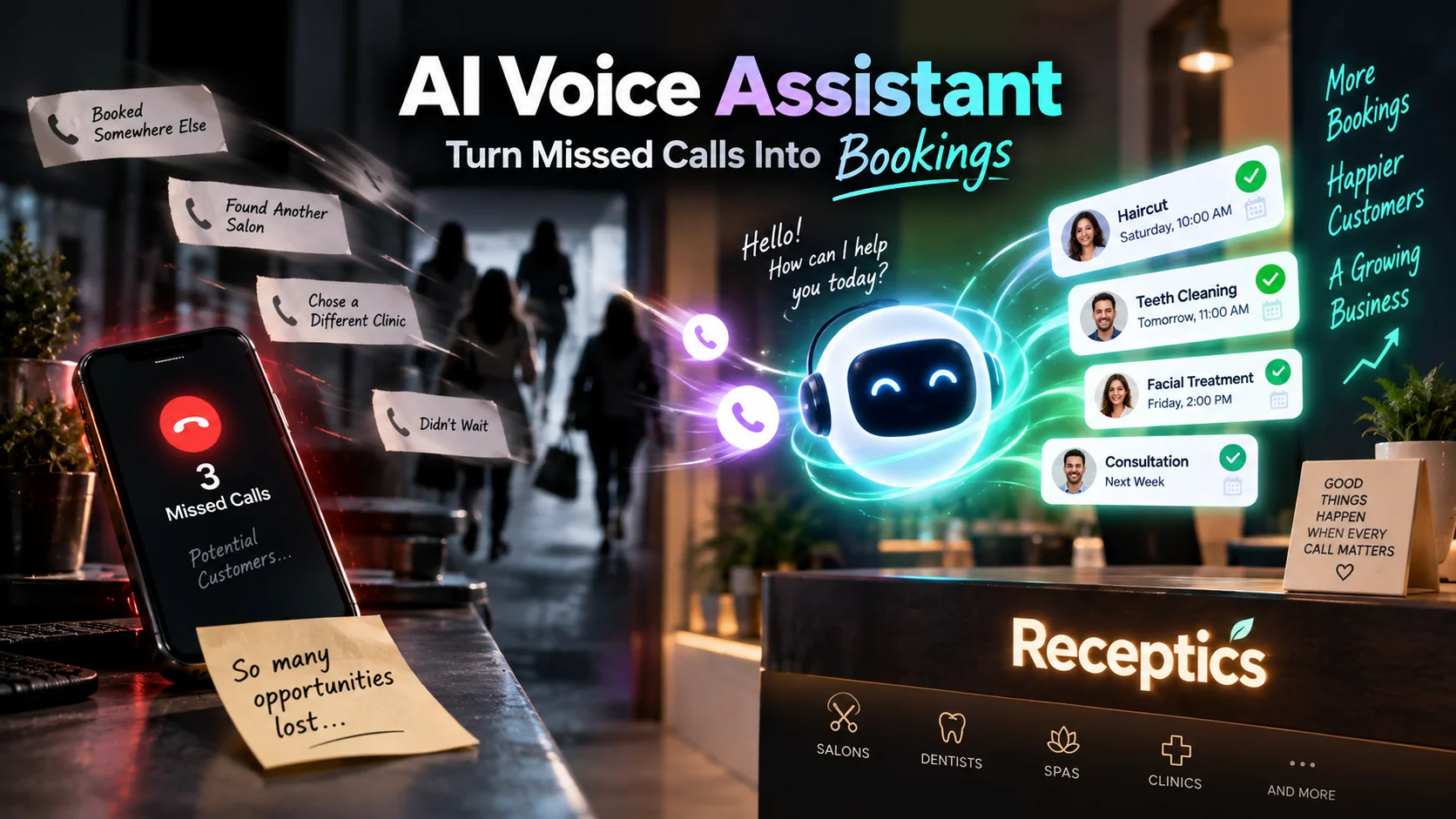
Your phone rings while you're with a customer.
You can't answer.
Five minutes later, that customer may already be calling another business.
This is a common problem for salons, dental clinics, spas, clinics and other appointment-based businesses. The issue isn't always getting more leads. Sometimes it's simply being available when an existing lead calls.
An AI voice assistant helps solve that problem by answering calls, talking naturally with customers and taking action while your team is busy.
What Is an AI Voice Assistant?
An AI voice assistant is an AI-powered system that can have natural conversations with customers over the phone.
The technology combines capabilities such as speech recognition, artificial intelligence and voice generation to understand what someone says and respond conversationally.
For readers interested in the technology behind modern AI systems, IBM's overview of artificial intelligence provides a useful introduction.
Unlike a traditional phone system:
“Press 1 for bookings. Press 2 for opening hours.”
Customers can simply say what they need.
Customer: “Do you have a haircut available tomorrow afternoon?”
The AI voice assistant can understand the request, check available appointments and respond with suitable times.
If the customer chooses one, it can help complete the booking.
That means a phone call doesn't have to end with:
“Sorry, nobody is available to take your call.”
It can end with:
“Perfect. Your appointment is confirmed for 3:30 PM.”
How Does an AI Voice Assistant Work?
To the customer, it feels like a normal conversation.
Behind the scenes, the AI processes what the caller says, determines what they are asking for and generates an appropriate response.
When connected to your business systems, it can also take action.
For example, a customer calls a dental clinic:
Customer: “I'd like to book a check-up on Friday morning.”
The AI checks the clinic's availability.
AI: “We have 9:30 AM and 11:00 AM available. Which works better for you?”
Customer: “11 AM.”
The AI collects the required details and books the appointment.
The customer gets what they wanted without waiting for someone at reception to become available.
Why Is This Useful for Salons?
A salon has a simple problem: the busiest moments inside the salon are often the hardest moments to answer the phone.
Your stylist shouldn't have to stop halfway through a haircut because someone is calling to ask:
“Do you have anything available today?”
And your receptionist shouldn't have to choose between helping the customer standing in front of them and answering another ringing phone.
An AI voice assistant can handle routine calls while your team continues working.
Customers can ask about services, prices, opening hours and appointment availability.
More importantly, they can book.
So even when the salon is busy—or closed for the evening—the opportunity doesn't necessarily disappear with the missed call.
How Can It Help Dental Clinics?
Dental clinics deal with a large amount of repetitive phone communication.
Patients call to ask:
“Are you accepting new patients?”
“Can I move my appointment?”
“Do you have anything tomorrow?”
“What time was my appointment?”
These are important calls, but they don't always require a receptionist.
An AI voice assistant can handle routine enquiries, scheduling, rescheduling and appointment-related questions while staff focus on patients who need their attention.
When a conversation requires a human, it can be handed over instead of forcing AI to handle something it shouldn't.
For healthcare businesses considering AI tools, privacy and patient information also need to be taken seriously. The U.S. Department of Health and Human Services' HIPAA guidance is an authoritative starting point for understanding U.S. health-information privacy requirements.
AI Voice Assistants Can Make Calls Too
The opportunity isn't limited to incoming calls.
An AI voice assistant can also make outbound calls.
Think about how much time businesses spend reminding customers about appointments.
Instead, an AI assistant can call:
“Hi Sarah, I'm calling to confirm your appointment tomorrow at 2 PM. Are you still able to make it?”
The customer can respond naturally.
If they need to reschedule, the conversation can continue from there.
This can be useful for appointment confirmations, reminders, follow-ups and other repetitive calls that otherwise consume staff time.
The Goal Isn't to Replace Your Receptionist
This is where AI voice assistants are often misunderstood.
The goal isn't necessarily to remove humans from your business.
It's to stop humans spending so much time doing repetitive work.
Your receptionist is much more valuable helping a customer with a complicated request than repeating your opening hours for the tenth time that day.
AI can handle the predictable conversations.
Your team can handle the ones where people matter most.
But Answering Calls Isn't Enough
There is one major problem with many AI calling solutions.
They answer the call—and stop there.
You then need another system for appointments.
Another for leads.
Another for reminders.
Another for customer information.
Another for analytics.
Suddenly you've added AI but also added more software for your team to manage.
A useful AI voice assistant shouldn't just be able to talk.
It should be able to complete the job.
That's Where Receptics Comes In
Receptics is designed around the complete journey from phone call to confirmed appointment.
A customer calls:
“Can I book a haircut this Saturday?”
The AI receptionist answers.
It understands what the customer needs.
It checks real availability.
It helps book the appointment.
But the workflow doesn't have to end when the call ends.
Receptics brings together the tools appointment-based businesses need to manage what happens before, during and after that conversation.
Businesses can use Receptics for 24/7 AI call answering, appointment booking, rescheduling, cancellations, lead capture, customer management, call recordings, transcripts, call summaries, appointment confirmations and reminders.
It can also support WhatsApp, SMS and AI voice communication, connect with Google Calendar, provide an online booking experience, manage staff and service availability, and help businesses understand their calls, leads and bookings through analytics.
Instead of your AI receptionist being another disconnected tool, it becomes part of the way your business actually operates.
From a Ringing Phone to Revenue
The value of an AI voice assistant isn't that it sounds impressive.
It's what happens after the phone rings.
A missed call can become a conversation.
A conversation can become a booking.
A booking can become a customer.
And your team doesn't have to drop what they're doing to make that happen.
For salons, dentists, spas, clinics and other appointment-based businesses, that's the real opportunity behind AI voice technology.
Customers don't care how complicated the technology is behind the scenes.
They simply want someone to answer when they call.
Receptics helps make sure someone does—and helps turn that conversation into the next step for your business.
Never let a valuable call end at “no answer.”
[See how Receptics works →] Receptics